
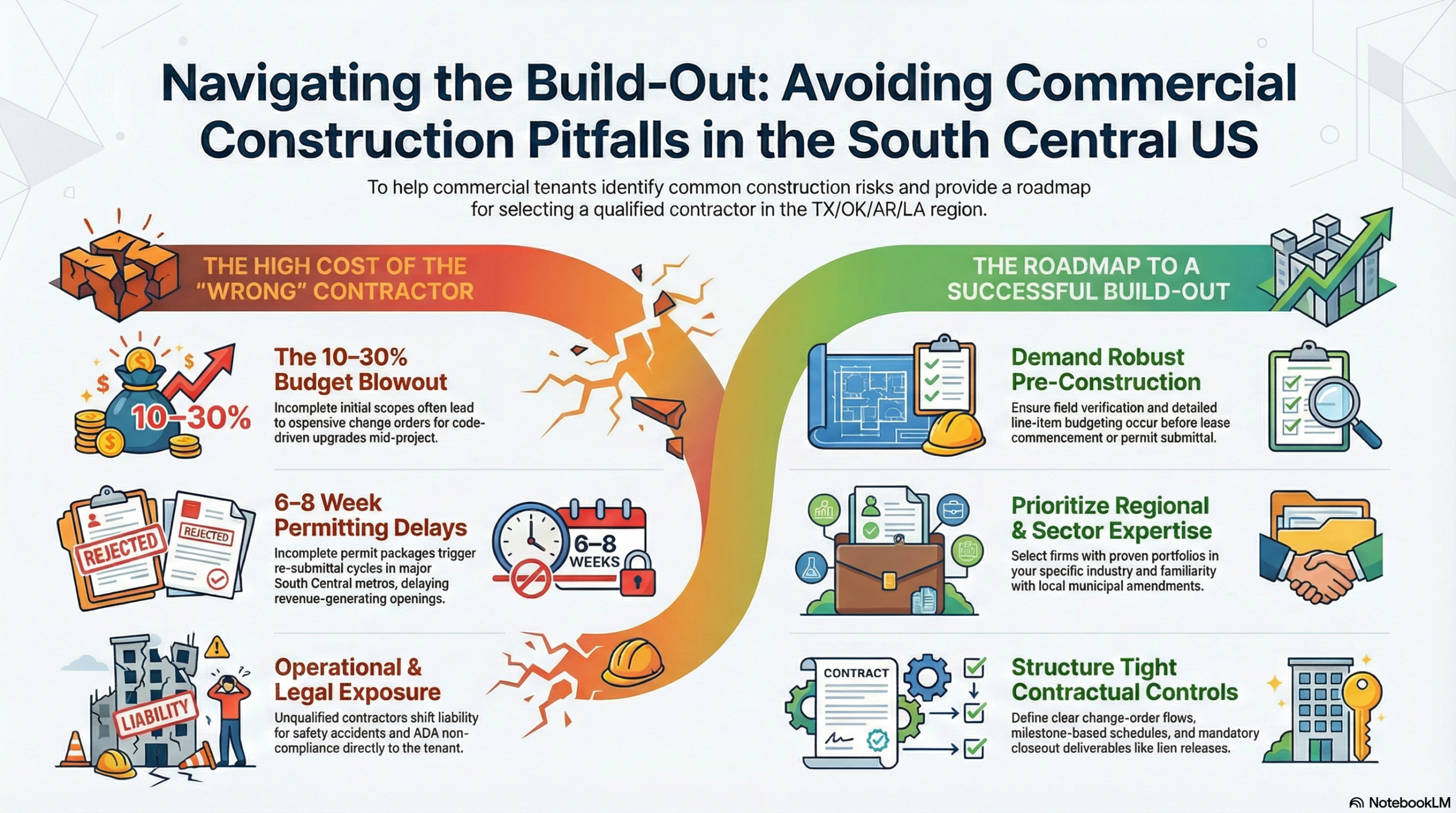
Many problems that commercial tenants face in remodels and build‑outs in Texas, Oklahoma, Arkansas, and Louisiana come from poor contractor selection: budget blowouts, delays, code/ADA failures, and disputes over scope and quality. The “wrong” contractor is usually one who is cheap, underqualified, and disorganized, or who lacks local code, permitting, and occupied‑space experience.
Regional context: TX / OK / AR / LA
-
These states follow International Building Code with local amendments, and cities like Dallas, Houston, Austin, San Antonio and others have strict submittal requirements (architectural, MEP, structural, accessibility, energy).
-
High scrutiny on ADA/accessibility, egress, and life‑safety; noncompliance can trigger re‑inspections, mandatory rework, fines, and delayed openings.
-
Weather, supply chain volatility, and subcontractor availability in Texas and the South Central region make schedule and budget risk higher if planning and contractor controls are weak.
Pitfall 1: Poor pre‑construction planning
When tenants choose a contractor who “jumps to demo” without robust pre‑construction, risk skyrockets.
-
Skipping thorough existing‑conditions review and scope definition leads to hidden structural, MEP, and code issues surfacing mid‑project as expensive change orders.
-
Lack of detailed plans and coordination with landlord criteria, TI allowance, and city permit requirements causes redesigns, denied permits, and weeks of delay.
How a good contractor mitigates it: Clear pre‑construction consulting, field verification, detailed scope, and realistic budget/schedule before lease commencement or at least before permit submittal.
Pitfall 2: Focusing on lowest bid instead of value
Tenants often pick the cheapest commercial contractor and pay more later.
-
Ultra‑low bids often omit scope, underestimate labor, or assume cheap materials, leading to serial change orders, schedule slips, and quality problems.
-
“Too good to be true” pricing may mask inexperience with commercial codes, occupied remodels, or your specific use (medical, restaurant, industrial), increasing failure risk.
Risk to tenants: Budget overruns, cash‑flow strain during ramp‑up, and compromised functionality or branding of the finished space.
Pitfall 3: Incomplete scope and hidden costs
Weak contractors often fail to surface complete scope early.
-
Common missing items: code‑driven upgrades (restrooms, exits, fire alarm/sprinkler modifications, HVAC capacity), landlord‑mandated shell corrections, and IT/low‑voltage needs.
-
Hidden costs show up as “unforeseen conditions,” material escalation, and excessive change orders that blow through TI allowance and tenant cash reserves.
Impact: Projects that started “in budget” end 10–30% over, forcing scope cuts, additional financing, or delaying other growth investments.
Pitfall 4: Weak permitting and code/ADA navigation
The wrong contractor underestimates or mishandles permitting in cities across Texas, Oklahoma, Arkansas, and Louisiana.
-
Incomplete permit packages (no MEP or accessibility plans, missing structural calcs) trigger review rejections and re‑submittals; Texas cities often quote 6–8 week review windows before any resubmission delay.
-
Poor understanding of ADA and life‑safety (door clearances, restroom counts, exit paths, emergency lighting) leads to failed inspections and forced rework after finishes are installed.
Business effect: Delayed opening, additional rent paid before revenue, and reputational damage if the space opens with unresolved compliance issues.
Pitfall 5: Licensing, insurance, and safety gaps
Tenants who assume credentials are in order expose themselves to major liability.
-
Contractors working with expired or insufficient licenses/insurance shift risk for worker injuries and property damage to the tenant and landlord.
-
Poor safety culture increases the chance of accidents, OSHA problems, or shut‑downs mid‑project.
Worst‑case: Tenant is named in injury lawsuits or must pay out‑of‑pocket for damage, on top of delays and rework.
Pitfall 6: Poor communication and project management
The wrong design‑build firm lacks structure.
-
No clear single point of contact, no regular updates, and vague schedules lead to misaligned expectations, unapproved changes, and disputes.
-
Weak coordination between landlord, tenant, architect, engineers, and city officials causes conflicting directives and stalled inspections.
Effect on tenant operations: Missed move‑in dates, confusion among staff, and difficulty planning hiring, inventory, or marketing around an uncertain opening.
Pitfall 7: Inexperience with occupied and multi‑tenant spaces
For remodels in strip centers, office towers, medical buildings, and retail centers, contractor experience in occupied environments is critical.
-
Inexperienced teams generate excessive dust, noise, and access disruptions that upset neighbors and customers, sometimes triggering lease disputes.
-
Poor phasing and off‑hours planning can force you to shut down or severely limit operations longer than necessary.
Result: Direct revenue loss during construction and strained relationships with landlord and co‑tenants.
Pitfall 8: Space planning and functionality failures
Contractors (and designers they bring) who don’t understand your use can build beautiful but dysfunctional spaces.
-
Poor layout relative to operational flow leads to double spending when tenants must reconfigure after discovering bottlenecks or code conflicts.
-
Incorrect occupant load and fixture counts (restrooms, exits, widths) can force late layout changes or occupancy limits.
Example: A restaurant that didn’t plan kitchen circulation, make‑line, and egress correctly ends up demolishing brand‑new walls and redirecting MEP runs after fire/life‑safety review.
Pitfall 9: Schedule slippage and missed lease milestones
The wrong general contractor often overpromises timelines.
-
Underestimating permit time, inspection cycles, long‑lead materials, and subcontractor availability leads to cascading delays.
-
Lack of milestone‑based scheduling and manpower planning results in idle days, compressed trades (stacking subs), and rushed, low‑quality work near the end.
Tenant consequences: Paying rent and overhead without revenue, risking default on “required opening” lease clauses, and burning marketing dollars on a space that isn’t ready.
Pitfall 10: Documentation, contracts, and change order abuse
Tenants who don’t scrutinize contract structure can be trapped.
-
Loose or vague contracts (scope, allowances, exclusions, change‑order process) give bad contractors room to nickel‑and‑dime tenants.
-
Lack of clear closeout requirements (as‑builts, warranties, lien releases) leaves tenants exposed if defects emerge after opening.
Impact: Budget shock from stacked change orders, difficulty reselling or subleasing space, and limited recourse if workmanship fails.
Pitfall 11: Quality and long‑term durability shortcuts
Weak contractors cut corners that don’t show until after move‑in.
-
Using substandard materials, skipping prep, or rushing MEP rough‑in/inspections can lead to frequent repairs, system failures, and cosmetic degradation.
-
Inadequate QA/QC and punchlist management means tenants discover issues while operating—when fixes are more disruptive and costly.
Long‑term effect: Higher maintenance costs, downtime, and accelerated need for another remodel before lease end.
How tenants can vet and choose the right contractor
These practices directly target the pitfalls above.
-
Verify licensing, insurance, and safety record for work in Texas, Oklahoma, Arkansas, and Louisiana; request certificates and confirm coverage explicitly includes commercial build‑outs.
-
Demand detailed pre‑construction: site verification, code/ADA review, landlord guidelines alignment, phased schedule, and a line‑item estimate with contingencies.
-
Prioritize experience: choose firms with proven tenant‑improvement portfolios in your building type (office, retail, medical, restaurant, industrial) and your metros.
-
Evaluate communication and process: look for documented project management systems, clear points of contact, and regular meeting/reporting cadence.
-
Structure contracts tightly: clear scope and exclusions, realistic allowances, defined change‑order flow, schedule milestones, and closeout deliverables.
Some projects demand more than a standard scope — they require experience, leadership, and the ability to think on your feet. Since 2014, Evolutionary Contractors has focused exclusively on commercial space build-outs, partnering with national retailers and growing franchise brands to deliver high-performance results. From developing a precise scope of work to executing within tight timelines and budgets, our team brings the discipline, coordination, and Texas work ethic needed to get complex projects across the finish line — done right the first time.